Cross-Border Contract Pitfalls: What Startups Miss
By Yourlegalassistant Team
INTRODUCTION
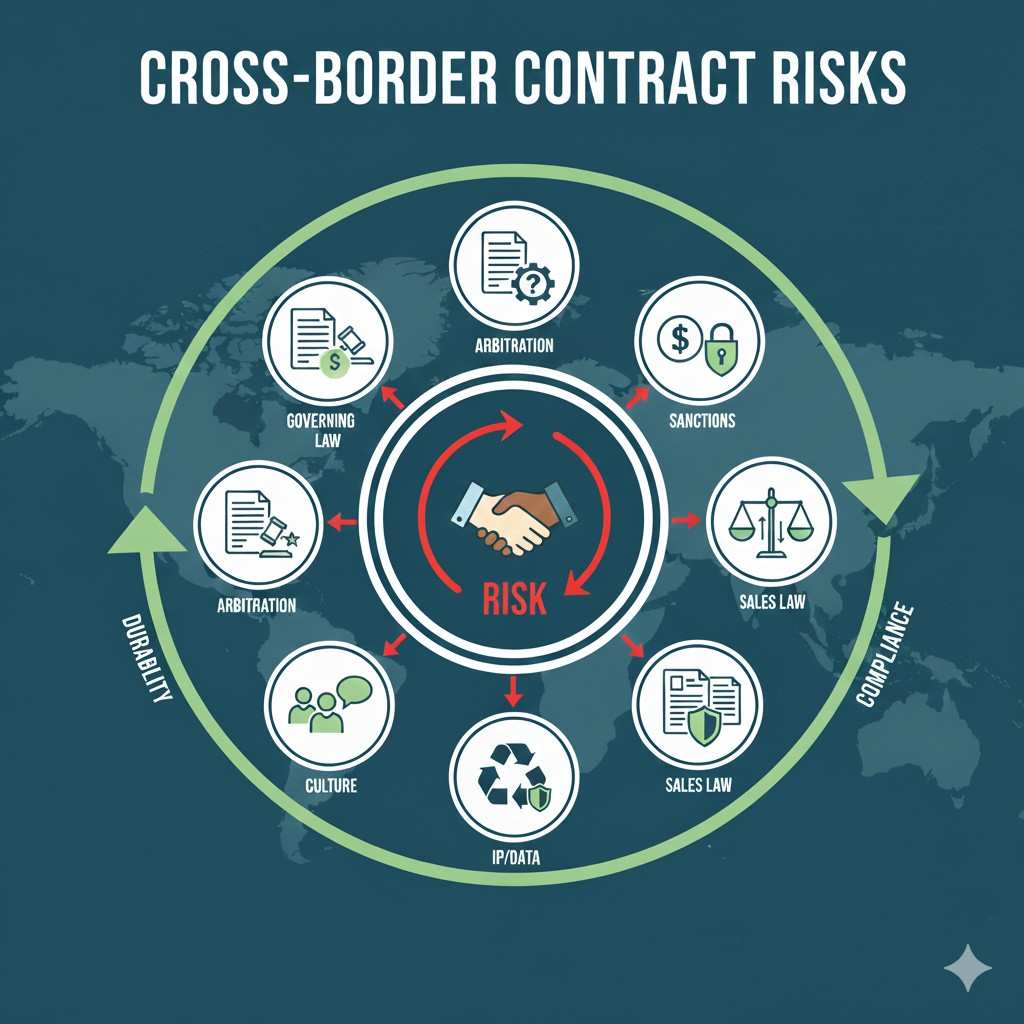
You’ve finally landed that dream customer overseas. The sales call went well, your deck impressed them, and now they’ve sent “their standard contract” asking you to sign quickly so the deal can close this quarter. For many U.S. startups, this is exactly where trouble starts; not with a data breach, not with a lawsuit, but with a quiet set of clauses on governing law, jurisdiction, sanctions, and IP that nobody really reads. Cross-border deals are not just “domestic contracts plus an international shipping address.” They sit at the intersection of U.S. state contract law, federal statutes like the Federal Arbitration Act and the Foreign Corrupt Practices Act, international instruments such as the New York Convention and the CISG, and the mandatory laws of at least one other country. When those moving parts are ignored, founders often sign away leverage, make promises they legally can’t keep, or discover too late that their “win” is unenforceable abroad.
1. Governing Law & Jurisdiction: The Clause Everyone Skims
Most cross-border disputes start with a deceptively simple question: Whose law applies, and where do we fight? U.S. law generally allows commercial parties to choose the law that governs their contract. Article 1 of the Uniform Commercial Code (UCC) expressly recognizes party autonomy in commercial transactions: under UCC sec. 1-301, when a transaction bears a reasonable relation to more than one jurisdiction, the parties may agree which state or nation’s law governs their rights and duties (with some consumer-protection carve-outs).
Startups often miss three common traps:
- No choice-of-law clause at all. In that case, a court falls back on general conflict-of-laws principles (e.g., the Restatement (Second) of Conflict of Laws), which may point to a foreign law you never studied and that treats key issues like limitation of liability or non-competition very differently.
- Mismatched governing law and forum. Some contracts choose New York law but require disputes to be heard in the other party’s country. In reality, this means you’ll end up fighting the case in a foreign court, in a foreign language, and paying experts just to explain New York law to that judge. It’s a costly way to learn that what’s considered “standard” in New York may not be acceptable at all in another legal system.
- Ignoring mandatory local rules. Even the best-drafted New York or Delaware clause cannot override foreign mandatory rules on employment, consumer protection, agents/distributors, or public policy. You might have a beautifully drafted termination clause that a foreign court simply refuses to apply.
Commentary from firms that routinely handle international disputes repeatedly stresses that poor or missing governing-law and jurisdiction clauses are among the biggest drivers of cross-border litigation cost. Harvard’s Program on Negotiation likewise notes that cross-border negotiations fail not only on price, but on “process” choices like where disputes will be resolved and under which legal regime.
2. Arbitration & Enforceability: When “We’ll Arbitrate” Is Not Enough
Because foreign court judgments can be difficult to enforce abroad, many cross-border contracts sensibly turn to international arbitration. In the U.S., the Federal Arbitration Act (FAA) (9 U.S.C. Sec. 1–16) establishes a strong national policy in favor of enforcing written arbitration agreements in contracts “involving commerce.”
For truly international deals, Chapter 2 of the FAA (9 U.S.C. sec. 201–208) implements the Convention on the Recognition and Enforcement of Foreign Arbitral Awards (the “New York Convention”) of 1958, which requires U.S. courts to recognize and enforce qualifying foreign arbitral awards, subject to narrow defenses.
Yet startups routinely stumble on details that make enforcement fragile:
- Unclear “seat” of arbitration. Saying only “disputes shall be submitted to arbitration” without designating a seat (e.g., New York, London, Singapore) can create uncertainty about which procedural law (lex arbitri) governs the arbitration. That, in turn, affects everything from interim relief to challenges to the award.
- Non-compliant arbitration clauses. Vague or hybrid clauses (“either party may litigate or arbitrate”) risk being deemed pathological or unenforceable under the New York Convention or local arbitration law.
- Misalignment with the New York Convention. If the clause or the parties fall outside the Convention’s scope, enforcing an award abroad becomes much harder.
The U.S. Supreme Court has repeatedly reinforced the pro-arbitration stance in cross-border contracts. In Mitsubishi Motors Corp. v. Soler Chrysler-Plymouth, Inc., the Court held that antitrust claims under the Sherman Act could be arbitrated in Japan under an international agreement, emphasizing the importance of predictability and comity in global commerce. Practical Law on Westlaw summarizes the FAA as “the basic legal framework for arbitration in the U.S.,” spanning both domestic arbitration (Chapter 1) and international arbitration under the New York Convention (Chapter 2).
3. CISG and the “Invisible” International Sales Law
Another quiet trap is the United Nations Convention on Contracts for the International Sale of Goods (CISG). For contracts for the international sale of goods between parties whose places of business are in different CISG-contracting states (including the U.S.), the CISG applies by default unless the parties clearly exclude it typically by saying “The United Nations Convention on Contracts for the International Sale of Goods does not apply.”
Many U.S. startups (and even some lawyers) assume they are dealing purely with the UCC. In reality:
- The CISG’s rules on offer and acceptance, risk of loss, and remedies differ from Article 2 of the UCC.
- Certain familiar U.S. boilerplate doesn’t “map” cleanly onto CISG concepts.
- Courts in the U.S. treat the CISG as a self-executing treaty with force of federal law, meaning it can pre-empt inconsistent state law.
If your cross-border contract involves goods rather than pure services or software, you should consciously decide: are you opting into the CISG, tailoring your clauses accordingly, or opting out and using UCC-style provisions instead? Silence leaves that decision to a judge later often in a foreign court.
4. Sanctions, Export Controls & Anti-Bribery: Compliance Clauses that Actually Bite
Cross-border contracts increasingly double as compliance documents. It’s not enough to say “each party will comply with applicable laws.” You need to think about which laws, and how non-compliance affects the deal.
Key U.S. regimes startups often overlook:
- Economic sanctions and OFAC. The U.S. Department of the Treasury’s Office of Foreign Assets Control (OFAC) administers sanctions programs that can make even routine payments illegal if your counterparty or their beneficial owner is on a sanctions list or in a comprehensively sanctioned country. OFAC’s Framework for Sanctions Compliance Programs specifically encourages risk-based screening and contractual controls, including representations, warranties, and audit rights. Recent enforcement actions show that even mid-sized companies can face multi-million-dollar penalties for seemingly small payments routed to sanctioned persons.
- Foreign Corrupt Practices Act (FCPA). The FCPA’s anti-bribery provisions (15 U.S.C. sec. 78dd-1 et seq.) prohibit U.S. issuers and “domestic concerns” from offering “anything of value” to foreign officials to obtain or retain business; amendments extend coverage to certain foreign persons acting in U.S. territory. The Department of Justice (DOJ) and SEC’s Resource Guide to the U.S. FCPA (Second Edition) lays out expectations for internal controls, third-party due diligence, and contractual protections.
From a contract-drafting perspective, this means:
- Your reseller or agent agreements should include explicit anti-bribery and sanctions clauses, audit rights, and clear termination rights for violations.
- Payment terms, discount structures, and “marketing allowances” should be scrutinized to avoid embedding a mechanism that could look like a disguised bribe under FCPA standards.
- You should specify who bears the risk and cost if a sanctions or anti-bribery violation makes performance impossible or illegal.
Newspaper coverage from outlets like The Wall Street Journal regularly highlights how rapidly changing sanctions regimes and geopolitical risks are complicating cross-border deals, especially for fast-growing companies expanding into new regions.
5. IP, Data & Local Mandatory Law: Where Templates Go to Die
When your counterparty is overseas, “standard U.S. IP boilerplate” is rarely enough. Common pitfalls include:
- Assuming “work-made-for-hire” travels. The U.S. Copyright Act’s “work-made-for-hire” concept is not universal. In many jurisdictions, creators retain strong default rights, and moral rights may be inalienable. Without a clear, signed IP assignment that works under both U.S. law and the foreign law, you may discover that your overseas developer owns critical code.
- Data protection and transfer rules. If your contract involves personal data of EU, UK, or other foreign residents, you may trigger the GDPR or similar regimes. That often requires standard contractual clauses, data-processing agreements, and representations about data localization or cross-border transfers.
- Employment and agency law. Some countries treat long-term “independent contractors” or distributors as employees or commercial agents with statutory compensation rights upon termination—rights you can’t waive by contract. Failing to account for this can turn what you thought was an at-will commercial relationship into a costly statutory severance event.
Harvard’s executive-level programs and research on international law and cross-border relationships repeatedly emphasize that legal risk in global agreements is not just about “what’s in the document,” but also about the local legal environment in which that document will be interpreted.
6. Culture, Communication & “Soft” Terms that Have Hard Consequences
Even where the legal drafting is solid, startups underestimate how cultural differences affect the interpretation and performance of cross-border contracts. Harvard Business Review and Harvard’s Program on Negotiation have shown that cross-cultural misunderstandings frequently derail deals or create disputes even when the black-letter terms look clear.
For example:
- A clause that seems like a gentle “best efforts” obligation in U.S. practice may be read as a hard commitment in another legal culture.
- Informal side-communications (“don’t worry, we’ll sort that later”) can be afforded more weight in some jurisdictions when interpreting ambiguous terms.
- Contract mechanisms for governance steering committees, escalation ladders, or regular review meetings can dramatically reduce the likelihood that a cross-border disagreement turns into a bet-the-company arbitration.
Newspaper and business-press coverage is full of stories of promising overseas expansions that faltered because cultural expectations around risk, timelines, or relationship-building weren’t aligned with what the contract assumed would happen.
LANDMARK U.S. JUDGMENTS SHAPING CROSS-BORDER CONTRACT RISK
· The Bremen v. Zapata Off-Shore Co. (1972):
Forum-selection clauses in international agreements are prima facie valid. The Court upheld a clause selecting the High Court of Justice in London as the exclusive forum for disputes arising under an international towage contract, holding that forum-selection clauses in international agreements are “prima facie valid” and should be enforced unless shown to be unreasonable, unjust, or the product of fraud or overreaching.
· Scherk v. Alberto-Culver Co. (1974):
International arbitration clauses function as specialized forum-selection clauses. The Court enforced an agreement to arbitrate in Paris under the rules of the International Chamber of Commerce, emphasizing that an international arbitration clause is “in effect, a specialized kind of forum-selection clause” and warning that refusing to enforce such clauses would jeopardize the reliability of international business transactions.
· Mitsubishi Motors v. Soler Chrysler-Plymouth (1985):
Even U.S. statutory antitrust claims can be arbitrated abroad. Court held that even U.S. statutory antitrust claims could be arbitrated abroad under the FAA and the New York Convention, underscoring the strong U.S. policy favoring arbitration in the international context.
· Shearson/American Express v. McMahon (1987):
Extended arbitrability to Securities Exchange Act and RICO claims. Court further extended arbitrability to Securities Exchange Act and RICO claims, reinforcing that sophisticated commercial parties entering cross-border transactions should expect their choice of forum and dispute-resolution mechanism to be respected absent extraordinary circumstances.
Together, these cases send a clear message: get your forum-selection and arbitration clauses right the first time, because U.S. courts are very likely to hold you to them.
CONCLUSION:
Cross-border contracts aren’t frightening they’re just different. The real pitfalls don’t come from complex foreign laws but from simple assumptions: assuming a U.S. contract template works worldwide, that a court judgment will be enforced overseas without complications, or that a generic “comply with laws” clause will magically cover sanctions, export controls, or FCPA exposure.
Before you finalize any international deal, ask yourself:
- Governing Law & Forum: Have we intentionally chosen both and do they actually align?
- Arbitration: Is our arbitration clause enforceable under the FAA and the New York Convention, with a practical seat and clear rules?
- CISG: Does the CISG apply to this deal, and is that what we want?
- Compliance Clauses: Do they really address sanctions, export controls, and anti-bribery risks, or just rely on buzzwords?
- IP & Data Rights: Are protections solid and enforceable under both U.S. and foreign legal systems?
- Governance: Do our communication and decision-making processes reflect how the relationship will actually operate across cultures?
If you can confidently answer “yes” after reviewing trusted legal sources, and research tools then you’re not merely signing a contract. You’re designing a durable, enforceable, and globally ready partnership that allows your startup to scale internationally without stepping on preventable legal landmines.
For tailored guidance on designing enforceable cross-border contracts, strengthening your compliance posture, or building a legally resilient international expansion strategy, connect with our team of experienced legal professionals at YLA.
FREQUENTLY ASKED QUESTIONS (FAQS):
1. Why are governing law and jurisdiction clauses important in international agreements?
These clauses determine which country’s laws apply and where disputes will be resolved. A mismatch for example, choosing New York law but requiring litigation in a foreign court can create cost, delay, and enforcement risks.
2. What is the biggest mistake startups make in cross-border contracts?
The most common mistake is signing “standard” foreign templates without reviewing governing law, dispute-resolution mechanisms, compliance obligations, or IP rights. This often leads to unenforceable rights or unexpected liability abroad.
3. How does international arbitration help in cross-border disputes?
International arbitration allows disputes to be resolved in a neutral forum. Under the Federal Arbitration Act (FAA) and the New York Convention, arbitral awards are widely enforceable across borders, often more easily than court judgments.
4. What is the New York Convention and why does it matter?
The New York Convention (1958) is an international treaty requiring courts in member countries to recognize and enforce foreign arbitral awards. It provides predictability and enforceability in cross-border arbitration agreements.
5. What is the CISG and does it apply automatically?
The Convention on Contracts for the International Sale of Goods (CISG) applies automatically to international sales of goods between parties in CISG-signatory countries unless the contract expressly excludes it. Many U.S. businesses mistakenly assume the UCC governs the deal when the CISG actually applies.
6. Do cross-border contracts need anti-bribery provisions?
Yes. The Foreign Corrupt Practices Act (FCPA) holds U.S. companies liable for bribery by their foreign agents or partners. Contracts should include anti-bribery warranties, audit rights, termination rights, and compliance obligations.
7. How can a startup reduce risk in cross-border agreements?
- Align governing law and forum
- Use enforceable arbitration clauses
- Decide whether to apply or exclude the CISG
- Add sanctions, export-control, and anti-bribery provisions
- Secure enforceable IP rights
- Establish clear communication and governance mechanisms
Legal review before signing is essential.
ABOUT THE AUTHOR
Adv. Sanjana Mishra is a corporate lawyer and legal content strategist specializing in corporate law, contract drafting, and regulatory compliance. She has experience drafting diverse commercial agreements and advising startups. Through YLA, she simplifies legal concepts to help businesses make informed, compliant, and growth-driven decisions.
DISCLAIMER
The information provided in this article is for general educational purposes and does not constitute a legal advice. Readers are encouraged to seek professional counsel before acting on any information herein. YLA and the author disclaim any liability arising from reliance on this content.

Related Articles

Leave a Comment