Data-Processing Agreements (DPAs) After New U.S. State Privacy Laws
By Yourlegalassistant Team
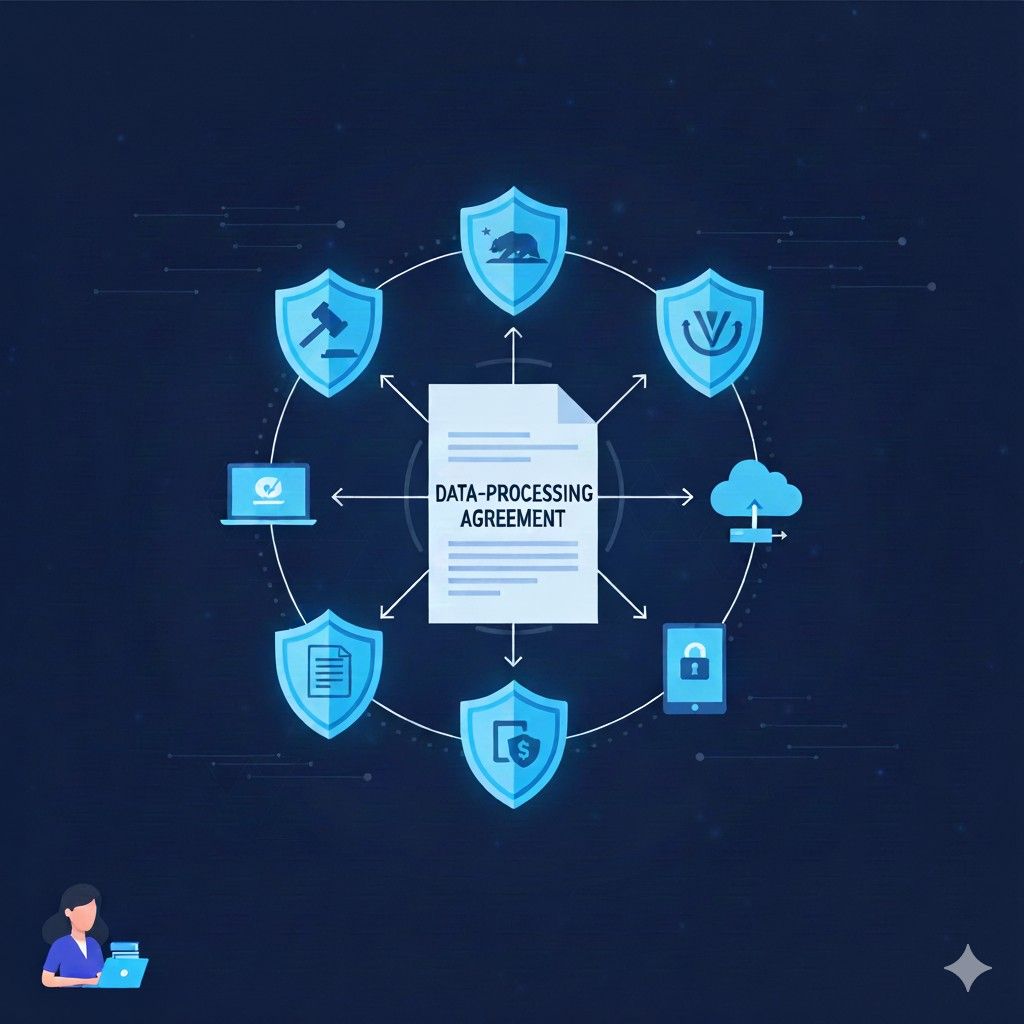
QUICK ANSWER
As U.S. states continue to enact and enforce comprehensive privacy laws, Data-Processing Agreements have evolved into critical compliance instruments for businesses that share personal data with vendors and service providers. Modern statutes such as the CCPA and CPRA in California, the Virginia Consumer Data Protection Act, and the Colorado Privacy Act require companies to exercise documented oversight over how personal data is processed, secured, and retained across the vendor ecosystem. This blog examines the shifting legal landscape that has elevated the importance of DPAs, outlines the essential contractual clauses required for state-law compliance, and offers practical drafting guidance for U.S. legal teams. It also analyses key enforcement trends and landmark judicial decisions that influence how regulators and courts evaluate data protection practices, concluding with a practical checklist and FAQs to help controllers and processors manage privacy risk effectively in an increasingly regulated environment.
Visit Your Legal Assistant’s (YLA) Blog Library for similar type of blogs for better understanding.
INTRODUCTION
For many years, data-processing agreements occupied a largely administrative role in U.S. contracting practices. They were signed as a matter of routine, reviewed lightly, and rarely treated as documents that could shape legal exposure in any meaningful way. That position has changed as state-level privacy regulation has expanded across the United States. Laws enacted in California, Virginia, Colorado, and other jurisdictions now impose clear expectations around how personal data is shared, managed, and safeguarded when third parties are involved.
These statutes do more than introduce new consumer rights. They reshape the legal relationship between businesses and their vendors by requiring documented accountability, defined processing limitations, and enforceable security commitments. As regulators increasingly examine how companies operationalize privacy compliance, data-processing agreements have become central evidence of governance rather than peripheral contract terms. A well-structured DPA now plays a decisive role in allocating responsibility, managing regulatory risk, and demonstrating good-faith compliance when scrutiny arises.
THE LEGAL LANDSCAPE SHAPING MODERN DPAS
The expansion of U.S. state privacy laws has fundamentally changed how companies must manage relationships with vendors that process personal data. While these statutes differ in structure, they share a common requirement: businesses that control personal data must impose clear, enforceable obligations on third-party processors through written agreements. As a result, Data-Processing Agreements have become a core component of privacy compliance rather than a secondary contractual formality.
1. California continues to set the national standard. The California Consumer Privacy Act, as amended by the California Privacy Rights Act, introduced detailed restrictions on how service providers and contractors may use personal and sensitive personal information. The CPRA also created the California Privacy Protection Agency, reflecting a more active enforcement environment. California guidance makes clear that vendor relationships must be governed by written contracts that limit data use, prohibit unauthorized sharing, and allow oversight.
2. Virginia’s Consumer Data Protection Act adopts a controller-processor framework that places contractual accountability at the centre of compliance. Controllers must ensure that processors act only on documented instructions, maintain confidentiality, and implement reasonable security measures. Written agreements are expressly contemplated by the statute, reinforcing the importance of DPAs in allocating responsibility between parties.
3. Colorado’s Privacy Act follows a similar approach while emphasizing risk-based compliance. It requires processors to assist controllers with statutory obligations and supports the use of contractual safeguards, including data protection assessments for higher-risk processing activities.
4. At the federal level, the Federal Trade Commission remains the primary privacy and data security enforcer. Through its authority over unfair or deceptive practices, the FTC has repeatedly emphasized that companies must meaningfully oversee service providers, not merely rely on contractual language.
5. The International Association of Privacy Professionals (IAPP) maintains an up-to-date tracker of state privacy laws and effective dates and is an excellent resource for monitoring new developments.
Taken together, these developments make one point clear. Data-Processing Agreements now operate as compliance instruments that must closely align with statutory requirements and enforcement priorities. Treating DPAs as generic boilerplate without reference to applicable state privacy laws exposes organizations to regulatory and contractual risk.
WHAT MODERN DPAS MUST COVER (CORE CLAUSES AND WHY THEY MATTER)
When updating or drafting a DPA for U.S. state-privacy compliance, counsel should ensure at minimum that the agreement addresses the following topics in clear, workable language:
1. Roles and Definitions. Identify who is the controller and who is the processor for each processing activity. Where the same vendor performs multiple roles, define the scope carefully so obligations attach to the correct function.
2. Permitted Processing and Purpose Limitation. State what data will be processed, for what purposes, and any limits on reuse or secondary uses (including targeted advertising or sale). Many states laws hinge on whether a transfer is a "sale" or a permitted service; the DPA should reflect whether the vendor may retain, use, or combine data beyond the controller’s instruction.
3. Security Measures and Audit Rights. Modern DPAs are expected to go beyond generic security assurances. They should outline baseline technical and organizational safeguards such as encryption, access controls, monitoring, and incident response practices, along with reasonable audit or reporting mechanisms. Federal Trade Commission enforcement actions consistently emphasize that companies must be able to demonstrate actual security practices, not just contractual promises.
4. Sub-processors and Flow-Downs. Require the processor to obtain written authorization before engaging sub-processors and to impose equivalent obligations on them. Include a process for notifying controller of new sub-processors and, where appropriate, an objection right.
5. Data Subject Rights Support. Define how the vendor will assist controllers in responding to consumer requests (access, deletion, portability, correction) and evidence required to demonstrate compliance.
6. Cross-Border Transfers and International Compliance. If data moves beyond U.S. borders, specify legal bases and safeguards. Even when governing law is U.S.-focused, DPAs should address international transfers to avoid conflict with partners or global regulators.
7. Retention, Return and Deletion. Establish timelines and secure deletion or return procedures following contract termination or upon controller instruction.
8. Liability, Indemnity, and Insurance. Allocate risks with clear caps and carve-outs for breaches of confidentiality, wilful misconduct, or statutory obligations. Consider requiring cyber insurance with defined minimums.
9. Breach Notification and Incident Management. Define notification timelines (often within 72 hours for severe incidents), roles, remediation steps, and cooperation mechanics.
10. Recordkeeping and Compliance Evidence. Require the processor to maintain records and provide regular attestations or SOC/ISO reports where relevant.
PRACTICAL DRAFTING TIPS FOR U.S. COUNSEL
When drafting or updating DPAs under U.S. state privacy laws, precision matters more than volume. Agreements should be specific enough to demonstrate compliance, yet flexible enough to work across vendors and use cases.
· Be granular in security commitments. Vague assurances such as “reasonable security measures” provide little protection during audits or enforcement inquiries. Instead, DPAs should either describe baseline technical and organizational controls or reference recognized frameworks such as SOC 2 or the NIST Cybersecurity Framework. Where possible, attaching a security schedule helps translate abstract obligations into verifiable practices.
· Map the data clearly. A well-structured processing schedule should identify the categories of personal data involved, the purposes of processing, retention periods, and any onward transfers. This schedule often becomes the most relied-upon document in regulatory inquiries, internal investigations, and litigation because it shows how data actually flows through the vendor relationship.
· Apply a risk-based approach. Not all data requires the same level of protection. DPAs should scale obligations based on the nature and sensitivity of the information processed and the potential impact of misuse or breach. Data involving health, financial details, precise location, or biometrics typically warrants enhanced security, shorter retention periods, and more robust audit rights.
· Address marketing and advertising use explicitly. Many state privacy laws treat data “sales” and targeted advertising differently from routine service processing. To avoid ambiguity, DPAs should clearly restrict the use of personal data for advertising, analytics, or profiling unless the controller has expressly authorized those activities.
· Standardize where possible, but plan for negotiation. Standard DPA templates are essential for managing high-volume vendor relationships, but legal teams should define clear escalation points. Issues such as sub processors, indemnification, audit scope, and data retention often require tailored negotiation and should not be left to default language.
LANDMARK JUDGMENTS (TWO U.S. DECISIONS THAT INFLUENCE DPAS)
1. FTC v. Wyndham Worldwide Corp., 799 F.3d 236 (3d Cir. 2015). The Third Circuit held that the FTC could bring enforcement action under its unfairness authority for inadequate data-security practices. The case underscores that contractual claims and vendor commitments cannot substitute for demonstrable operational security. In practice, DPAs should reflect not only promises on paper but operational proof (logs, assessments, incident response testing) that can be shown to regulators.
2. Carpenter v. United States, 138 S. Ct. 2206 (2018). Although a constitutional Fourth Amendment case about government access to cell-site location records, Carpenter reshaped expectations about privacy in third-party data and signals courts’ sensitivity to precise rules about access and retention. For DPAs, Carpenter reinforces the importance of limiting retention and specifying narrow, lawful bases for access and disclosure of personal data to third parties.
A SHORT CHECKLIST: DPA READINESS FOR CONTROLLERS AND PROCESSORS
As U.S. state privacy laws impose clearer accountability across the data-processing chain, both controllers and processors should periodically assess whether their DPAs are fit for purpose. The following checklist highlights core compliance questions that legal teams should be able to answer confidently.
1. For Controllers
Controllers should confirm that every vendor relationship is supported by a current DPA with an attached processing schedule identifying data categories, purposes, retention periods, and transfers. Vendors should be able to demonstrate compliance with recognized security standards, such as SOC 2 or ISO certifications, rather than relying on generic assurances.
DPAs should clearly prohibit any data use that would conflict with consumer privacy laws, including unauthorized sales, profiling, or targeted advertising. In addition, agreements should include a defined sub-processors framework and enforceable retention and deletion obligations.
2. For processors and vendors
Processors should assess whether they can meet contractual timelines for data subject request support and breach notification, particularly for customers subject to California and other comprehensive state privacy laws. Standard terms should allow for flow-down obligations and reasonable audit or reporting rights.
Vendors should also ensure that their cyber insurance coverage aligns with market expectations and that a standardized security schedule tied to verifiable frameworks is readily available to support DPA negotiations.
ENFORCEMENT AND THE PRACTICAL STAKES
U.S. privacy enforcement has moved steadily from theory to practice. State attorneys general and the Federal Trade Commission have made clear that privacy compliance is judged not by the presence of contractual language alone, but by whether companies actually follow through on the obligations those contracts describe. Recent enforcement actions and regulatory guidance show a consistent focus on operational reality, including vendor oversight, data security controls, and incident response readiness.
The FTC, in particular, has repeatedly emphasized that companies cannot rely on generic assurances from service providers. Instead, organizations are expected to implement reasonable measures to monitor compliance, address known risks, and ensure that data protection commitments are reflected in day-to-day practices. FTC guidance on data security underscores that written agreements must be supported by documented controls, testing, and internal accountability mechanisms.
State privacy regulators have echoed this approach. Enforcement under laws such as the CCPA and CPRA reflects an expectation that businesses actively manage vendor relationships through enforceable DPAs, clear processing limitations, and demonstrable safeguards. Regulators increasingly examine how data flows across the vendor ecosystem and whether contractual restrictions are meaningfully implemented.
The practical takeaway is straightforward. DPAs should function as living compliance instruments, closely tied to security programs, audits, and reporting processes. In enforcement inquiries, regulators assess the entire compliance chain, not just the contractual language, making operational alignment essential to reducing regulatory and litigation risk
CONCLUSION
Data-Processing Agreements are no longer optional legal niceties; they are critical compliance instruments in a fragmented but evolving U.S. privacy landscape. Drafted well, DPAs allocate responsibility, enable operational monitoring, and reduce regulatory and litigation risk. For U.S. companies and vendors alike, the imperative is clear: translate legal obligations from statutes into precise contractual language, map them to technical controls, and maintain evidence that those commitments are operational.
FREQUENTLY ASKED QUESTIONS
Q1. Are Data-Processing Agreements required under U.S. state privacy laws?
Many U.S. state privacy laws, including the CPRA, VCDPA, and Colorado Privacy Act, require or strongly encourage written contracts governing controller-processor relationships. While requirements vary by statute, DPAs are widely treated as essential compliance documents.
Q2. Can a vendor’s standard terms satisfy state-law DPA requirements?
Sometimes, but only if the vendor’s terms meet statutory requirements and include necessary operational commitments. Controllers should insist on specific annexes or schedules where the vendor’s standard language is insufficient.
Q3. How detailed should technical security descriptions be in a DPA?
More detail is better. Reference to recognized standards (SOC 2, NIST CSF) plus a brief schedule describing encryption, access control, and monitoring is recommended. Regulators value verifiable controls over vague promises.
Q4. What should breach notification timelines look like in a DPA?
Many organizations aim for an initial notification within 48–72 hours of discovery, with a commitment to follow-up reports. The DPA should align with any tighter statutory timelines and include cooperation mechanics.
Q5. Can a controller restrict a processor from engaging sub processors?
Yes. Controllers commonly require written consent before sub-processors are engaged and reserve the right to object or require mitigation measures.
Q6. How long should data be retained under a DPA?
Retention should be purpose-limited and as short as reasonably necessary. Define fixed retention periods or tie retention to the lifecycle of the controller-customer relationship and specify secure deletion methods.
Q7. What documentation supports DPA compliance during audits or enforcement?
Useful evidence includes SOC or ISO reports, data-flow maps, incident response records, penetration testing summaries, and sub-processors lists. Regulators expect proof of implementation, not just contractual language.
AUTHOR BIO
Pooja Joshi is a corporate lawyer specializing in business contracts, corporate governance, and compliance strategy. She has worked extensively with developing firms and legal-tech platforms, preparing and analysing a wide range of agreements, from vendor contracts and NDAs to high-value M&A negotiations. Her writing blends legal precision with practical insight, helping make complex legal concepts more accessible to People from non-legal background.
DISCLAIMER
The information provided in this article is for general educational purposes only and does not constitute legal advice. Readers are encouraged to seek professional counsel before acting on any information herein. Your Legal Assistant (YLA) and the author disclaim any liability arising from reliance on this content.

Related Articles

Leave a Comment